Chemistry Journal of Moldova
- Journal Citation Reports for year 2025:
- Impact Factor (IF) 0.5;
- 5-year Journal IF 0.6;
- SCOPUS Journal Metrics for year 2025:
- CiteScore 0.9;
- Source Normalized Impact per Paper (SNIP) 0.334;
- SCImago Journal Rank (SJR) 0.152.




TOP DOWNLOADED ARTICLES
1. SONOCHEMICAL SYNTHESIS OF HEMATITE
NANOPARTICLES
Mihail Iacob
(downloads: 1345)
2. THE ROLE OF HALOGEN BONDING IN THE
SYNTHESIS AND DESIGN OF TAP COMPLEXES
Namiq Shikhaliyev, Ayten Niyazova, Abel Maharramov, Agaisa Askerov, Nazrin Zeynalli, Viktor Khrustalev, Peri Huseynova
(downloads: 940)
3. SILVER AND ZINC NANOPARTICLES
BIOSYNTHESIS USING LAUREL EXTRACT AND
INVESTIGATION OF THE PHOTOCATALYTIC
PROPERTIES
Recep Taş, Ebru Köroğlu, Ahmet Karakuş, Ali Savaş Bülbül, Nilay Akkuş Taş
(downloads: 910)
4. SYNTHESIS OF DIFFERENT STRUCTURAL TYPES
OF ZEOLITES IN THE
HALLOYSITE-DOLOMITE-OBSIDIAN SYSTEM
Gunel Mamedova
(downloads: 872)
5. DERIVATIZATION TECHNIQUES BASED ON
CHARGE TRANSFER REACTIONS FOR
SPECTROPHOTOMETRIC DETERMINATION OF
JOSAMYCIN IN VARIOUS DOSAGE FORMS
Abdelghani Mahmoudi and Ann Van Schepdael
(downloads: 832)
6. A NOVEL GREEN SYNTHESIS OF NICKEL OXIDE
NANOPARTICLES USING ARABIC GUM
Saeid Taghavi Fardood, Ali Ramazani, Sajjad Moradi
(downloads: 809)
7. SYNTHESIS, CHARACTERIZATION AND
MOLECULAR DOCKING OF CHLORO-SUBSTITUTED
HYDROXYXANTHONE DERIVATIVES
Emmy Yuanita, Harno Dwi Pranowo, Mustofa Mustofa, Respati Tri Swasono, Jufrizal Syahri, Jumina Jumina
(downloads: 659)
8. ORGANOCHLORINE PESTICIDES RESIDUES IN
SOIL OF SOROCA DISTRICT, REPUBLIC OF
MOLDOVA
Elena Culighin
(downloads: 509)
9. ROLE OF CYCLODEXTRINS IN NEW
ANTIMYCOBACTERIAL FORMULATIONS
Veaceslav Boldescu, Fliur Macaev, Gheorghe Duca
(downloads: 503)
10. INVESTIGATION OF VARIOUS INFLUENCING
FACTORS OF HYDROTHERMAL SYNTHESIS OF
ANALCIME ZEOLITE
Gunel Mamedova, Gunel Nasirli
(downloads: 490)
NANOPARTICLES
Mihail Iacob
(downloads: 1345)
2. THE ROLE OF HALOGEN BONDING IN THE
SYNTHESIS AND DESIGN OF TAP COMPLEXES
Namiq Shikhaliyev, Ayten Niyazova, Abel Maharramov, Agaisa Askerov, Nazrin Zeynalli, Viktor Khrustalev, Peri Huseynova
(downloads: 940)
3. SILVER AND ZINC NANOPARTICLES
BIOSYNTHESIS USING LAUREL EXTRACT AND
INVESTIGATION OF THE PHOTOCATALYTIC
PROPERTIES
Recep Taş, Ebru Köroğlu, Ahmet Karakuş, Ali Savaş Bülbül, Nilay Akkuş Taş
(downloads: 910)
4. SYNTHESIS OF DIFFERENT STRUCTURAL TYPES
OF ZEOLITES IN THE
HALLOYSITE-DOLOMITE-OBSIDIAN SYSTEM
Gunel Mamedova
(downloads: 872)
5. DERIVATIZATION TECHNIQUES BASED ON
CHARGE TRANSFER REACTIONS FOR
SPECTROPHOTOMETRIC DETERMINATION OF
JOSAMYCIN IN VARIOUS DOSAGE FORMS
Abdelghani Mahmoudi and Ann Van Schepdael
(downloads: 832)
6. A NOVEL GREEN SYNTHESIS OF NICKEL OXIDE
NANOPARTICLES USING ARABIC GUM
Saeid Taghavi Fardood, Ali Ramazani, Sajjad Moradi
(downloads: 809)
7. SYNTHESIS, CHARACTERIZATION AND
MOLECULAR DOCKING OF CHLORO-SUBSTITUTED
HYDROXYXANTHONE DERIVATIVES
Emmy Yuanita, Harno Dwi Pranowo, Mustofa Mustofa, Respati Tri Swasono, Jufrizal Syahri, Jumina Jumina
(downloads: 659)
8. ORGANOCHLORINE PESTICIDES RESIDUES IN
SOIL OF SOROCA DISTRICT, REPUBLIC OF
MOLDOVA
Elena Culighin
(downloads: 509)
9. ROLE OF CYCLODEXTRINS IN NEW
ANTIMYCOBACTERIAL FORMULATIONS
Veaceslav Boldescu, Fliur Macaev, Gheorghe Duca
(downloads: 503)
10. INVESTIGATION OF VARIOUS INFLUENCING
FACTORS OF HYDROTHERMAL SYNTHESIS OF
ANALCIME ZEOLITE
Gunel Mamedova, Gunel Nasirli
(downloads: 490)



Inorganic and coordination chemistry
Author(s):
Field: Inorganic and coordination chemistry
Type: Research paper
Issue: 2017 Volume 12, no.2
Pages: 34-40
Masahiro Mikuriya, Iyo Matsushima, Daisuke Yoshioka
Field: Inorganic and coordination chemistry
Type: Research paper
Issue: 2017 Volume 12, no.2
Pages: 34-40
Full Text (PDF): Download
Abstract (PDF)
Graphical Abstract: Mixed-valent trinuclear manganese complex with N,N’-bis(2-hydroxy-3,5-dimethylbenzyl-N,N’-dimethyl-1,2-ethanediamine (H2hdde), [Mn3(hdde)2(CH3CO2)2(CH3O)2], was synthesized. The X-ray crystal structure analysis revealed a linearly arrangement of MnIII-MnII-MnIIIcore, where a ferromagnetic coupling (J = 2.62 cm–1) between the MnIII and MnII ions.
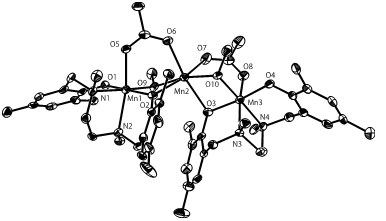
Graphical Abstract: Mixed-valent trinuclear manganese complex with N,N’-bis(2-hydroxy-3,5-dimethylbenzyl-N,N’-dimethyl-1,2-ethanediamine (H2hdde), [Mn3(hdde)2(CH3CO2)2(CH3O)2], was synthesized. The X-ray crystal structure analysis revealed a linearly arrangement of MnIII-MnII-MnIIIcore, where a ferromagnetic coupling (J = 2.62 cm–1) between the MnIII and MnII ions.
Downloads: 61
Author(s):
Field: Inorganic and coordination chemistry
Type: Research paper
Issue: 2017 Volume 12, no.2
Pages: 28-33
Inna Seifullina, Elena Martsinko, Elena Chebanenko, Eleonora Afanasenko, Viktoriya Dyakonenko, Svitlana Shishkina
Field: Inorganic and coordination chemistry
Type: Research paper
Issue: 2017 Volume 12, no.2
Pages: 28-33
Full Text (PDF): Download
DOI: dx.doi.org/10.19261/cjm.2016.369
Abstract (PDF)
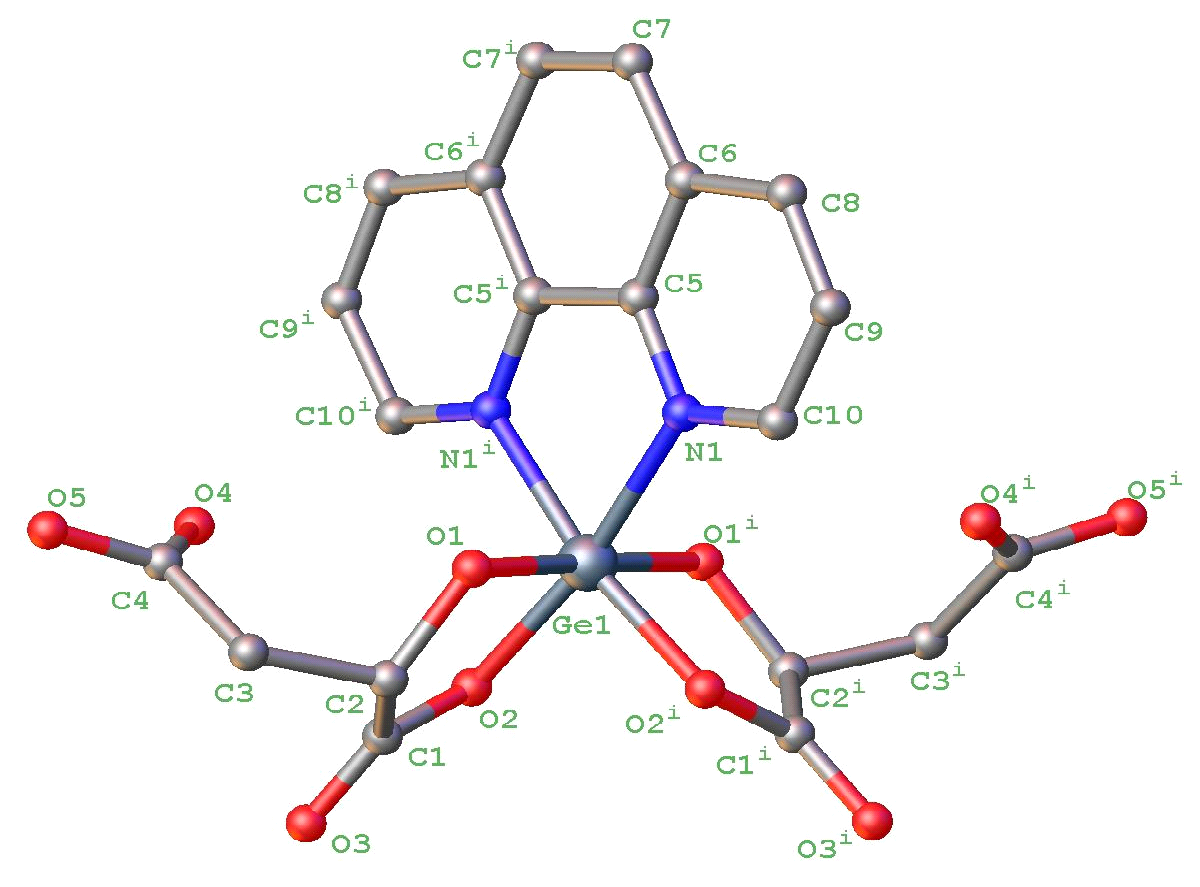
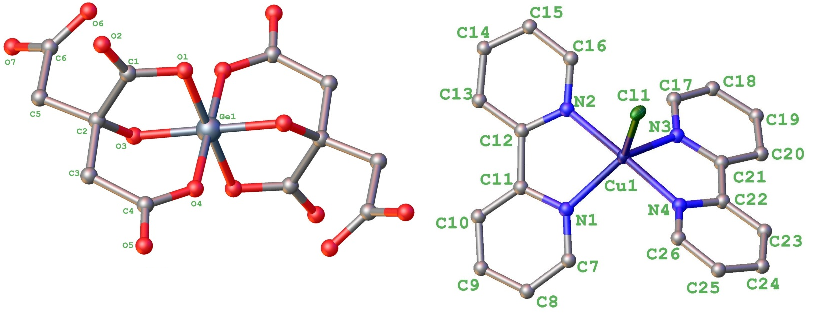
Graphical Abstract: Two crystalline compounds of germanium(IV) with malic acid (HMal) and 1,10ʹ-phenanthroline (phen) - [Ge(HMal)2(phen)]•pheh•2H2O (I) and [CuCl(phen)2][Ge(OH)(HMal)2] (II) were synthesized for the first time and characterized by elemental analysis, IR-spectroscopy and thermogravimetric analysis. There was elucidated from single-crystal X-ray diffraction that two different forms of Germanium are implemented: Ge4+ (I) and hydrolyzed GeOH3+ (II) to form distorted octahedron and pyramid respectively.
Downloads: 110
Author(s):
Field: Inorganic and coordination chemistry
Type: Research paper
Issue: 2017 Volume 12, no.1
Pages: 74-80
Olesea Cuzan
Field: Inorganic and coordination chemistry
Type: Research paper
Issue: 2017 Volume 12, no.1
Pages: 74-80
Full Text (PDF): Download
DOI: dx.doi.org/10.19261/cjm.2016.370
Abstract (PDF)
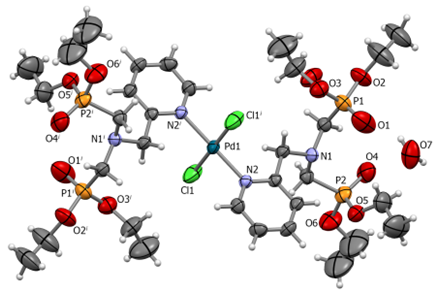
Graphical Abstract: The novel N-(methylene-2-pyridine)-N,N-bis(diethoxyphosphorylmethyl)amine ligand (L) was obtained through a double Kabachnik-Fields reaction, starting from 2-aminomethyl pyridine (2-picolylamine). Based on the L ligand, a new palladium(II) coordination compound [Pd(L)2Cl2] has been synthetized and comprehensively characterized by spectroscopic methods (1H NMR, UV-Vis), ESI mass spectrometry and X-ray crystallography.
Downloads: 115
Author(s):
Field: Inorganic and coordination chemistry
Type: Research paper
Issue: 2016 Volume 11, no.2
Pages: 52-57
Inna Seifullina, Elena Martsinko, Elena Chebanenko, Olha Pirozhok, Viktoriya Dyakonenko, Svitlana Shishkina
Field: Inorganic and coordination chemistry
Type: Research paper
Issue: 2016 Volume 11, no.2
Pages: 52-57
Full Text (PDF): Download
Graphical Abstract: The crystalline compounds (Hbipy)2[Ge(HCitr)2]•2H2O (1) and [CuCl(bipy)2]2[Ge(HCitr)2]•8H2O (2) (where H4Citr is citric acid, bipy is 2,2ʹ-bipyridine) were obtained for the first time and their structures were determined by the single-crystal X-ray diffraction method. The two compounds were characterized by IR spectroscopy, thermogravimetric (TGA) and elemental analyses. In both compounds complex bic(citrato)germanate anion is formed, protonated 2,2'-bipyridine molecule and [Cu(bipy)2Cl]+ complex are cations in 1 and 2, respectively.
Downloads: 82
Author(s):
Field: Inorganic and coordination chemistry
Type: Research paper
Issue: 2016 Volume 11, no.1
Pages: 33-38
Haruka Dote, Hiroki Yasuhara, Satoru Nakashima
Field: Inorganic and coordination chemistry
Type: Research paper
Issue: 2016 Volume 11, no.1
Pages: 33-38
Full Text (PDF): Download
DOI: dx.doi.org/10.19261/cjm.2016.11(1).04
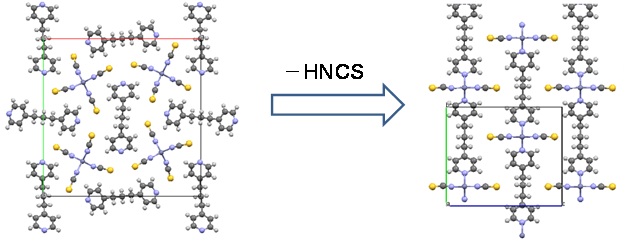
Graphical Abstract: Several types of crystals having different color appeared in the synthesis of assembled complex of mixed crystals with three metals. [H2(bpp)][M(NCS)4] changed to 1D chain polymer (M(NCS)2(bpp)) by releasing HNCS from the cation and anion in a reaction vessel.
The article is Open Access by CC-BY 4.0 License
Cite this article as: H. Dote, H. Yasuhara, S. Nakashima. The Formation Mechanism of Assembled Complexes Bridged by 1,3–Bis(4–Pyridyl)propane. Chemistry Journal of Moldova, 2016, 11(1), pp. 33-38. DOI: dx.doi.org/10.19261/cjm.2016.11(1).04
Article Source: The Formation Mechanism of Assembled Complexes Bridged by 1,3–Bis(4–Pyridyl)propane.
Download article metadata: CrossRef BibTeX CERIF Google Scholar DataCite Dublin Core
Downloads: 60
Author(s):
Field: Inorganic and coordination chemistry
Type: Research paper
Issue: 2016 Volume 11, no.1
Pages: 39-49
Ion Bulhac, Alexandra Deseatnic-Ciloci, Paulina Bourosh, Janetta Tiurina, Olga Bologa, Cezara Bivol, Steliana Clapco, Ana Verejan, Svetlana Labliuc, Olga Danilescu
Field: Inorganic and coordination chemistry
Type: Research paper
Issue: 2016 Volume 11, no.1
Pages: 39-49
Full Text (PDF): Download
DOI: dx.doi.org/10.19261/cjm.2016.11(1).05
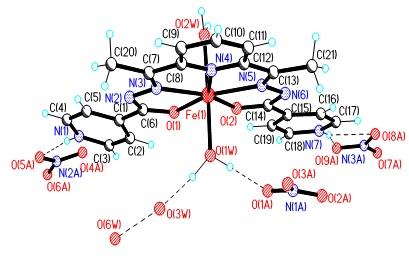
Graphical Abstract: Four coordination compounds of iron(III) with ligands based on hydrazine and sulfadiazine: FeCl3·digsemi·2H2O (I) (digsemi-semicarbazide diacetic acid dihydrazide, [Fe(HL)SO4] (II) (НL - sulfadiazine), [Fe(H2L1)(H2O)2](NO3)3·5H2O (III) (H2L1-2,6-diacetylpyridine bis(nicotinoylhydrazone) and [Fe(H2L2)(H2O)2](NO3)3•1.5H2O (IV) (H2L2 - 2,6-diacetylpyridine bis(isonicotinoylhydrazone) were synthesized. The spectroscopic and structural characterisation as well as their biological, properties are presented.
The article is Open Access by CC-BY 4.0 License
Cite this article as: I. Bulhac, A. Deseatnic-Ciloci, P. Bourosh, J. Tiurina, O. Bologa, C. Bivol, S. Clapco, A. Verejan, S. Labliuc, O. Danilescu. Structure and Some Biological Properties of Fe(III) Complexes with Nitrogen-Containing Ligands. Chemistry Journal of Moldova, 2016, 11(1), pp. 39-49. DOI: dx.doi.org/10.19261/cjm.2016.11(1).05
Article Source: Structure and Some Biological Properties of Fe(III) Complexes with Nitrogen-Containing Ligands.
Download article metadata: CrossRef BibTeX CERIF Google Scholar DataCite Dublin Core
Downloads: 122
Author(s):
Field: Inorganic and coordination chemistry
Type: Research paper
Issue: 2015 Volume 10, no.2
Pages: 33-39
Diana Chisca, Eduard Coropceanu, Oleg Petuhov, Lilia Croitor
Field: Inorganic and coordination chemistry
Type: Research paper
Issue: 2015 Volume 10, no.2
Pages: 33-39
Full Text (PDF): Download
DOI: dx.doi.org/10.19261/cjm.2015.10(2).03
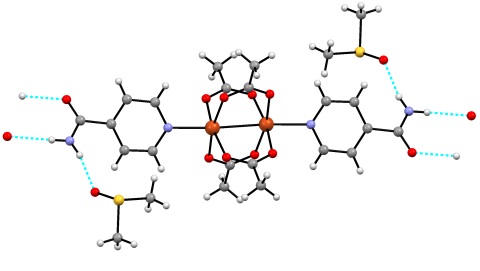
Graphical Abstract: Dinucleartetracarboxylato-bridged copper(II)solvato-morph [Cu2(OAc)4(ina)2] •2dmso was prepared and studied by IR spectroscopy, TGA analysis and single crystal X-ray method. Cu(II) ions are bridged by four syn,syn-η1:η1:μ carboxylates, showing a paddle-wheel cage-type with a square-pyramidal geometry.
Downloads: 61
Author(s):
Field: Inorganic and coordination chemistry
Type: Research paper
Issue: 2015 Volume 10, no.2
Pages: 40-47
Masahiro Mikuriya, Mayu Hamagawa, Natsuki Tomioka, Daisuke Yoshioka, Naoko Uehara, Rika Fujimori, Hiroki Yamamoto, Yoshinari Ando, Shoichi Hori, Taro Kuriyama, Ryoji Mitsuhashi, Makoto Handa
Field: Inorganic and coordination chemistry
Type: Research paper
Issue: 2015 Volume 10, no.2
Pages: 40-47
Full Text (PDF): Download
DOI: dx.doi.org/10.19261/cjm.2015.10(2).04
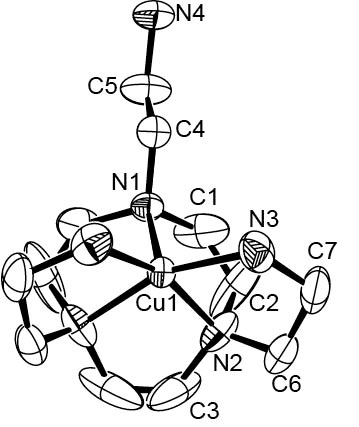
Graphical Abstract: Three kinds of copper(II) complexes with 1,4,7-tris(2-aminoethyl)-1,4,7-triazacyclononane (taetacn), [Cu(taetacn)](ClO4)2 (1), [Cu(Htaetacn)](ClO4)3 (2), and [Cu(Htaetacn)](BF4)3 (3) were synthesized and characterized by elemental analyses, IR and UV-Vis spectroscopies. The spectral features are in harmony with an octahedral geometry for 1 and a square-pyramidal coordination for 2 and 3.
Downloads: 68
Author(s):
Field: Inorganic and coordination chemistry
Type: Research paper
Issue: 2015 Volume 10, no.2
Pages: 48-53
Masahiro Mikuriya, Kenta Ono, Shun Kawauchi, Daisuke Yoshioka, Ryoji Mitsuhashi, Makoto Handa
Field: Inorganic and coordination chemistry
Type: Research paper
Issue: 2015 Volume 10, no.2
Pages: 48-53
Full Text (PDF): Download
Abstract (PDF)
DOI: dx.doi.org/10.19261/cjm.2015.10(2).05
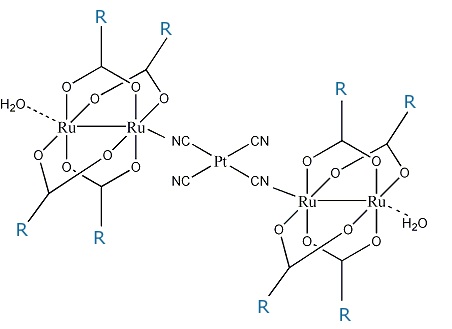
Graphical Abstract: Mixed-metal complexes constructed from dinuclearruthenium(II,III) carboxylates and tetracyanidoplatinate(II), [{Ru2(O2CCH3)4}2Pt(CN)4]•2H2O (1) and [{Ru2{O2CC(CH3)3}4}2Pt(CN)4]•2H2O (2), were synthesized and characterized by elemental analysis and IR and UV-vis spectroscopies.
DOI: dx.doi.org/10.19261/cjm.2015.10(2).05
Graphical Abstract: Mixed-metal complexes constructed from dinuclearruthenium(II,III) carboxylates and tetracyanidoplatinate(II), [{Ru2(O2CCH3)4}2Pt(CN)4]•2H2O (1) and [{Ru2{O2CC(CH3)3}4}2Pt(CN)4]•2H2O (2), were synthesized and characterized by elemental analysis and IR and UV-vis spectroscopies.
Downloads: 67
Author(s):
Field: Inorganic and coordination chemistry
Type: Short communication
Issue: 2015 Volume 10, no.2
Pages: 95-98
Maria Cocu, Stefan Manole
Field: Inorganic and coordination chemistry
Type: Short communication
Issue: 2015 Volume 10, no.2
Pages: 95-98
Full Text (PDF): Download
Abstract (PDF)
DOI: dx.doi.org/10.19261/cjm.2015.10(2).13
Graphical Abstract: We have investigated the properties as dyes of coordination compounds synthesized by us previously (8-(1',2'-naphthyl)-1-R-3-methyl-6-thiomethyl-4,5,7-triazanona-1,3,5,7-tetraenato-1,1'-diolato(-)-O1, O1', N4, N7-vanadil, where R=CH3 (1) , C6H5 (2)), which can be used for colouring thermoplastic masses. The compounds have a high photostability (7 points), thermostability (>250°) and an intensity of colour that give a low consumption (0.006-0.010g).
Downloads: 35
DOI: dx.doi.org/10.19261/cjm.2015.10(2).13
Graphical Abstract: We have investigated the properties as dyes of coordination compounds synthesized by us previously (8-(1',2'-naphthyl)-1-R-3-methyl-6-thiomethyl-4,5,7-triazanona-1,3,5,7-tetraenato-1,1'-diolato(-)-O1, O1', N4, N7-vanadil, where R=CH3 (1) , C6H5 (2)), which can be used for colouring thermoplastic masses. The compounds have a high photostability (7 points), thermostability (>250°) and an intensity of colour that give a low consumption (0.006-0.010g).
Downloads: 35